Solar Homes Continue to Outpace Phoenix Real Estate Market – May 2024

Phoenix solar home sales statistics for May 2024

Phoenix’s Solar Home Market in May 2024: A Detailed Analysis of Trends and Economic Impact

As the Phoenix housing market moves from spring into summer, the solar home sector continues to showcase distinctive trends that differentiate it from the broader market. This past April, we’ve observed nuanced changes in pricing, sales volume, and market dynamics that provide deeper insight into the state of solar home sales. With environmental consciousness on the rise and economic factors at play, solar homes in Phoenix are not just a niche market but a significant part of the housing landscape.

Current Trends in Solar Home Pricing and Sales

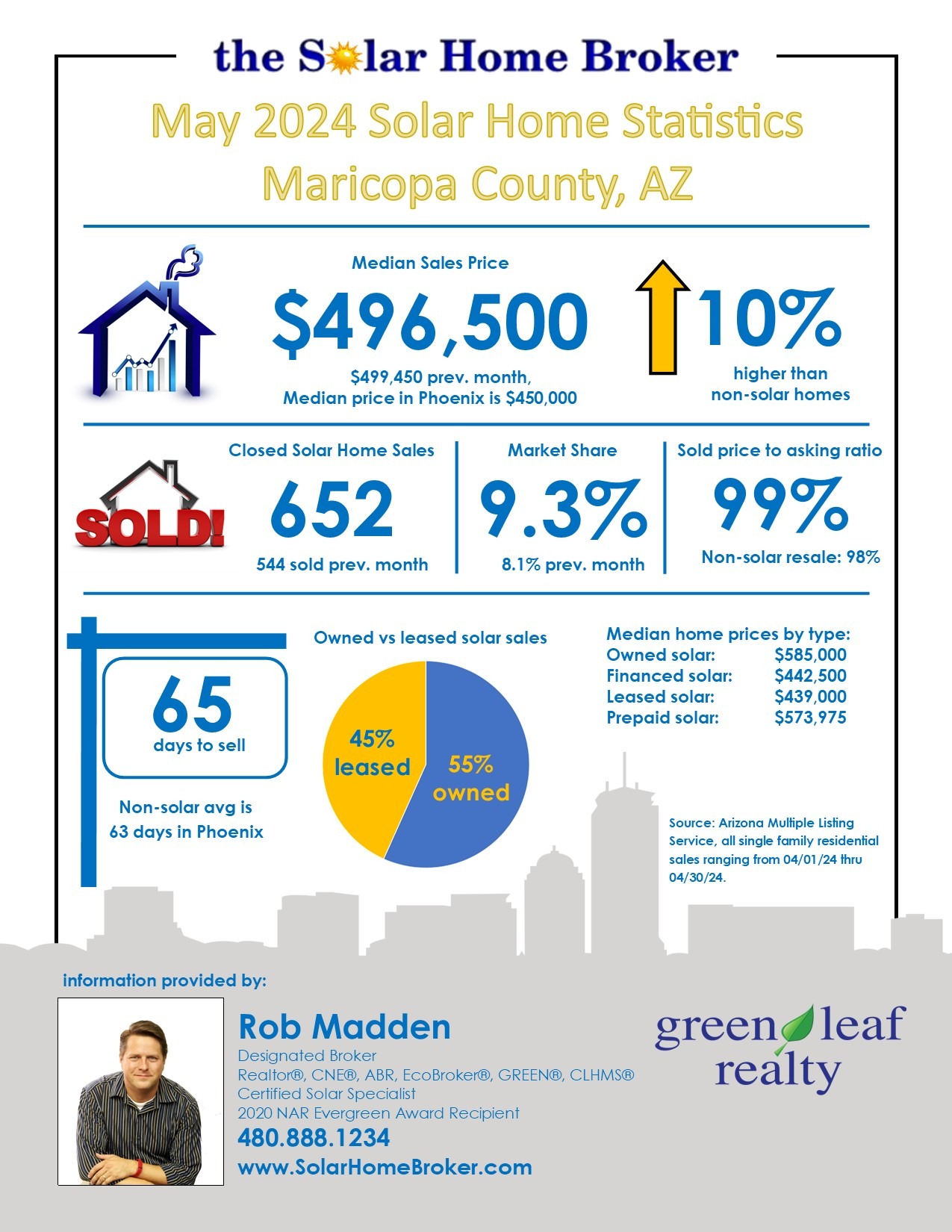
In April 2024, the median price for all solar homes in Phoenix rose to $496,500, marking a decrease from $499,450 in March. The specifics of the market, however, reveal more detailed shifts:

  • Owned Solar Systems: Homes with owned solar systems saw an increase in median price to $585,000 from March’s $562,500. These homes remain highly valued, suggesting that homeownership combined with solar capabilities is highly sought after due to the long-term savings and independence from utility companies.
  • Financed Solar Systems: The median price for homes with financed solar systems decreased to $442,500 from $452,000. This decline may reflect changing credit conditions or buyer caution in a fluctuating economic environment.
  • Leased Solar Systems: Homes with leased solar systems experienced a slight decrease to $439,000 from $449,500, indicating a steady interest in more affordable solar home options.
  • Prepaid Solar Lease Systems: The median price for homes with prepaid solar leases saw a significant adjustment to $573,975 from $608,675, possibly due to their perceived long-term value and the elimination of ongoing lease payments.

Comparison with the Broader Market

The median price for all resale homes in Phoenix was $450,000, which is slightly less than the median price for solar homes, reinforcing the premium that buyers are willing to pay for solar features. The broader market saw a mild increase from $444,945 in March, indicating steady growth across the board.

In terms of sales volume, 652 solar homes were sold in April, accounting for 9.3% of the total resale volume. This represents a significant segment of the market dedicated to environmentally friendly living solutions.

Historical Context and Year-over-Year Changes

Comparing year-over-year data, the median price of solar homes has increased by an impressive margin from April 2023, significantly outpacing the general market’s growth. This robust appreciation reflects the increasing valuation of solar technology in residential properties. However, the volume of solar homes sold has experienced fluctuations, suggesting market dynamics influenced by various factors such as economic conditions and buyer preferences.

Market Health and Economic Indicators

Phoenix’s housing market remains tight with just above 17,000 units available, up 39% from last year, yet still limited in the context of growing demand. With a supply of just 2.4 months, the market conditions favor sellers, keeping competition high among buyers. Foreclosure rates remain low, indicating a healthy market overall.

Mortgage rates have stabilized around 7%, still higher than the preferred 5% or lower, which continues to impact buyer affordability and seller willingness to list properties. The economic outlook is cautiously optimistic, buoyed by controlled inflation and the potential for interest rate reductions by the Federal Reserve, which could invigorate the market further.

Conclusion

As we analyze the solar home market in Phoenix in April 2024, it’s clear that these homes are more than just an eco-friendly option; they are a significant and growing component of the housing market landscape. With their ability to attract higher offers and close at rates above non-solar homes, solar properties offer compelling value, both in terms of real estate investment and environmental impact. Looking ahead, the solar home market in Phoenix is poised for continued growth and evolution, shaped by technological advancements, economic factors, and increasing consumer demand for sustainable living options.

You can download a PDF version of this report by clicking: https://www.solarhomebroker.com/wp-content/uploads/2024/05/Maricopa-Solar-Stats-May-2024.pdf

A version of this article can be found at: https://www.phoenixhomebuying.com/maricopa-county-solar-home-sales-may-2024/
Phoenix Solar Home Sales in Nov 2023: Rising Demand Amid Market Changes

December solar home sales statistics for Phoenix AZ

November 2023 in Phoenix’s real estate market has been marked by intriguing developments, particularly in the solar home sector. Amidst broader economic challenges and seasonal market trends, solar homes have shown resilience and a unique trajectory.

Median Prices for Solar Homes in Phoenix

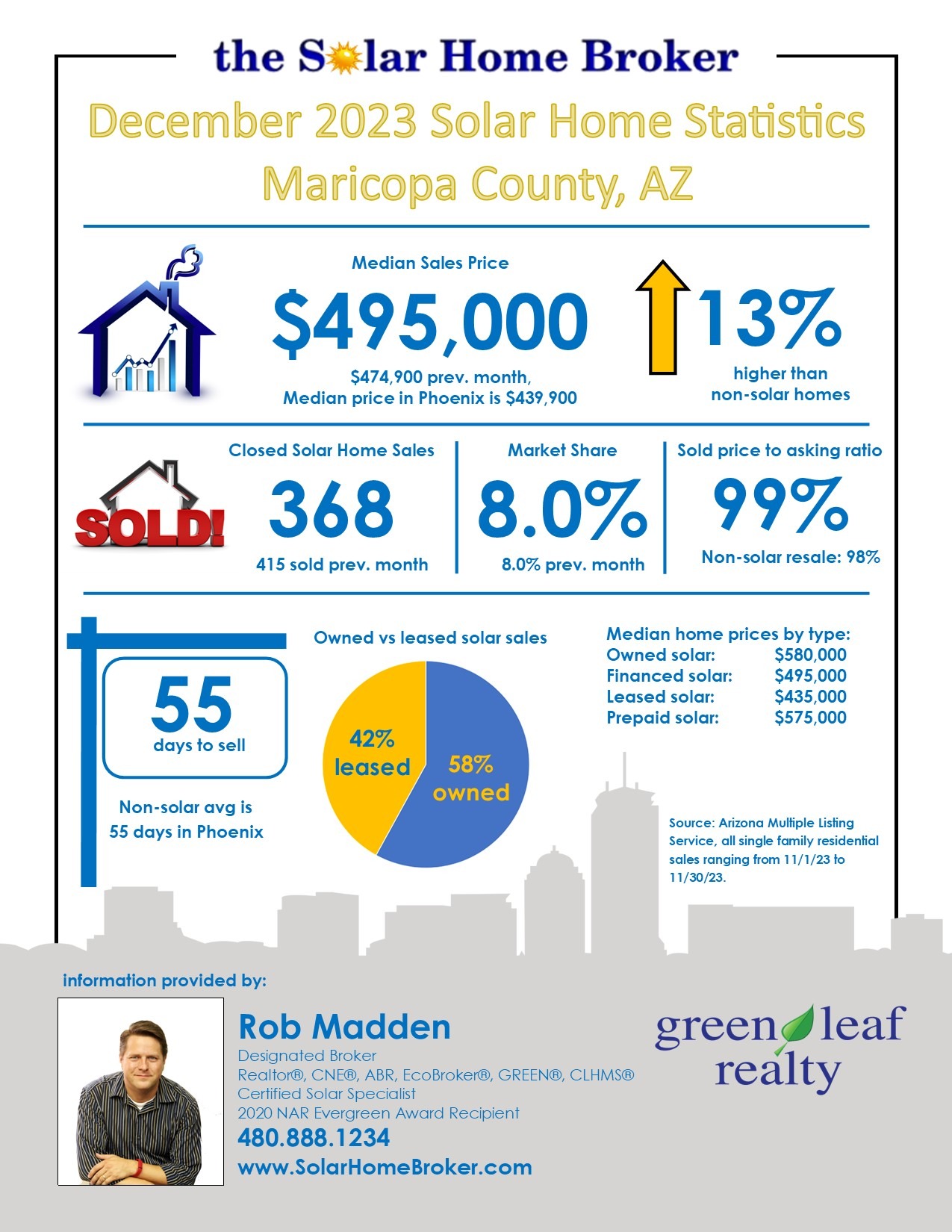
The median price for solar homes in November stood at $495,000, marking a slight decrease from October’s $474,900. However, this headline figure conceals more nuanced movements within different categories of solar homes. Owned solar system homes saw a significant increase to $580,000 from October’s $550,000, indicating robust demand for these premium, energy-independent properties. Meanwhile, financed solar system homes also saw a rise in median price to $495,000, up from $474,000. On the other hand, leased solar system homes experienced a modest increase to $435,000, and homes with prepaid solar lease systems witnessed a decrease to $575,000 from the previous month’s $618,850. These fluctuations across different types of solar homes suggest varying levels of market sensitivity to broader economic conditions.

Comparatively, the median price for all resale homes in Phoenix was $439,900, up from October’s $435,000. This incremental increase across the board reflects a steady market, albeit with the subtle impacts of broader economic forces at play.

Total Solar Home Sales in Phoenix in November

A total of 368 solar homes were sold in November, representing 8.0% of the total resale volume. While this volume is a slight decrease from October, it is significant in the context of the year-over-year increase of 5.7%. Sellers of solar homes received 99% of their asking price, outperforming the 98% received by sellers of non-solar homes. This higher achievement rate indicates a continued and perhaps growing appeal of solar homes among buyers.

Ownership trends within the solar market have also seen a shift, with 58% of the sales being owned solar systems, up from 50.3% the previous month, and 42% being leased systems. This suggests an increasing inclination towards owning solar infrastructure, possibly driven by a desire for long-term savings and environmental considerations.

In the broader historical context, the median price of solar homes has increased by 5.02% year over year, compared to the overall resale market in Phoenix, which saw a more modest increase. This highlights the enduring appeal and perceived value of solar homes in a market that is becoming increasingly conscious of sustainability and energy efficiency.

Overall Analysis of Solar Home Sales in November

The general health of the Phoenix housing market continues to be shaped by several factors. Inventory levels remain low, with just under 16,000 homes, although this is a 37% increase compared to three months ago. The supply of homes stands at about 3.5 months, indicating a market that is neither overstocked nor severely under-supplied. Foreclosure rates remain negligible, but the high mortgage rates continue to temper buyer enthusiasm. The gradual retreat from the 8% mortgage rates offers some relief, yet the market remains cautious.

Additionally, the seasonal slowdown typically observed during the holiday season further impacts market dynamics. This period often sees a reduction in new home inventory and sales, aligning with the traditional patterns of the real estate market.

In conclusion, Phoenix’s solar home market in November 2023 tells a story of resilience and adaptability. Despite economic headwinds and seasonal market shifts, solar homes continue to attract buyers, reflecting a broader shift towards sustainable living. As mortgage rates and market conditions evolve, the solar home segment in Phoenix remains a key area to watch, offering insights into the future of residential real estate in the region.

You can download the report here: https://www.solarhomebroker.com/wp-content/uploads/2023/12/Maricopa-Solar-Stats-Dec-2023.pdf

Solar Homes in Phoenix: A Steady Beacon in a Tumultuous Market November 2023

November 2023 Phoenix solar home sales statistics

As the year 2023 wanes, the Phoenix housing market continues to display its unique dynamics, particularly within the solar home segment. October’s data paints a picture of resilience and nuanced shifts, especially when contrasted with the broader market.

The median price for solar homes in Phoenix for October stood at $474,900, a slight uptick from September’s $469,500. This increase, subtle yet indicative, reveals more when dissected. Homes with owned solar systems, which traditionally lead the market in terms of value, saw a decrease to $550,000 from September’s $565,000. However, homes with financed solar systems experienced a climb to $474,000, a notable jump from the previous month’s $449,950. Likewise, leased solar system homes edged up to $425,000, and those with prepaid solar lease systems markedly increased to $618,850. These figures suggest a diversifying market where different types of solar systems cater to varied buyer preferences and economic capacities.

The median price for all resale homes in Phoenix was $435,000, marginally up from September’s $432,190, demonstrating a broader market resilience. The solar home sector, however, continues to outperform the general market in certain aspects. A total of 415 solar homes were sold, representing 8.0% of October’s total resale volume. This sales figure, while slightly lower than September’s, remains significant and underlines the steady demand for solar-equipped properties.

Notably, sellers of solar homes received 100% of their asking price, outshining the 98% received by sellers of non-solar homes. The close balance between owned (50.3%) and leased (49.7%) solar systems in sales underscores a market that appreciates both the long-term investment of ownership and the flexibility of leasing.

Historically, the median price of solar homes has risen by 3.24% from October 2022, showcasing a year-over-year growth that contrasts with the broader resale market’s stagnation. Additionally, the volume of solar homes sold has increased by 13.7% year over year, a testament to the growing appeal of eco-friendly living in the face of climate challenges.

The general market health in Phoenix, however, reflects the complexities of the current economic environment. Inventory levels remain tight, with just below 16,000 homes available, a 37% increase from three months ago. This inventory translates to a three-month supply, indicating a market that is neither overflowing nor excessively strained. Foreclosure rates, at a minimal 0.5%, reinforce this view of a market not plagued by distress sales.

Mortgage rates, having recently retreated from the 8% high, continue to exert pressure on the market. The higher rates are deterring some potential buyers, especially those reminiscing about the sub-5% era. Sellers, too, are reluctant to exchange their low-interest rate mortgages for the uncertainty of current rates. This hesitancy on both ends keeps the inventory levels from ballooning, maintaining a balance in the market.

In conclusion, as we navigate through October 2023, Phoenix’s solar home market emerges as a segment marked by resilience and adaptability. The fluctuating prices across different solar home categories reflect a market that is responding to diverse buyer needs and economic realities. With mortgage rates being a key influencer, the future trajectory of this market will likely hinge on broader economic trends. However, the sustained interest in solar homes highlights a deeper, more enduring shift towards sustainability – a trend that may well define the future of residential real estate in Phoenix.

You can download a PDF version of the monthly solar sales statistics here: https://www.solarhomebroker.com/wp-content/uploads/2023/11/Maricopa-Solar-Stats-Nov-2023.pdf

Phoenix Solar Homes: Seamless Sunrun Transfer Guide

Sunrun solar transfer in Phoenix AZ

Simplifying the Transfer of Sunrun Solar Service for Home Sellers in Phoenix, AZ

When it comes to selling solar homes in Phoenix, AZ, one of the critical aspects that both home sellers and buyers need to navigate is the transfer of solar service agreements. Specifically, for homes equipped with Sunrun Solar Services, understanding and executing this process is crucial. In this article, we delve into the necessary steps and provide insights on making this transition as seamless as possible.

Sunrun Solar Transfers

The Sunrun Solar Service Transfer process is straightforward and demands attention to detail from both the home seller and buyer. As soon as a seller receives an offer on their solar home, they should promptly contact Sunrun by emailing servicetransfers@sunrun.com, providing essential contact information for both parties involved. It’s crucial for the seller to also authorize their listing agent to act on their behalf throughout the transfer process, ensuring all aspects of ownership and responsibility are adequately addressed.

Both the seller and buyer are required to sign the “Transfer of Sunrun Solar Service Agreement,” a document that is sent electronically for convenience. This stage also involves the buyer completing a soft credit application, ensuring that they meet the necessary financial criteria without affecting their credit score or home loan prospects.

To finalize the transfer, proof of title transfer must be submitted after closing, and this can include a variety of legal documents such as a final settlement statement or a recorded grant deed. It is recommended that the solar agreement and its transfer are disclosed early in the home selling process and made a contingency of the sale. This proactive approach ensures that all parties are aware of the commitments and processes involved, minimizing potential issues and misunderstandings.

When selling a solar home in Phoenix, AZ, choosing professionals familiar with rooftop solar, such as agents, lenders, and title companies, is vital. Rob Madden with Green Leaf Realty, a Realtor specializing in solar homes, brings expertise and understanding to the table, ensuring that the transfer process is handled efficiently.

Communicating Sunrun Solar Benefits

Additionally, it’s beneficial to communicate the advantages of Sunrun Solar Services to potential buyers. Highlighting that the home provides less expensive power at a fixed rate, and emphasizing the fast-selling nature of solar homes, can attract buyers and facilitate a quicker sale. Also, positioning the home as a hybrid solution, receiving electricity from both Sunrun and the local utility company, appeals to environmentally conscious buyers.

Sunrun’s popularity among homeowners is evident, with 75% of homeowners choosing third-party solar services over outright ownership. By choosing a Realtor specializing in solar homes, such as Rob Madden with Green Leaf Realty, sellers can navigate the transfer of Sunrun Solar Service smoothly, ensuring a positive experience for all parties involved and maximizing the appeal of their solar home in the competitive Phoenix real estate market.

In conclusion, selling a solar home in Phoenix, AZ, requires a comprehensive understanding of the Sunrun Solar Service transfer process. By following the outlined steps, choosing experienced professionals, and effectively communicating the benefits of Sunrun services, sellers can ensure a seamless transition and attract eco-conscious buyers, ultimately contributing to a successful and efficient sale.

A version of this article can be found at: https://www.phoenixhomebuying.com/guide-to-transferring-sunrun-solar-services-for-phoenix-home-sellers/

Phoenix Solar Calculator: The Power of the Kilowatt Hour

solar calculator

Solar Calculator – Watt’s your kilowatt number?

Phoenix basks in the glory of sunshine, and it’s not just about golden sunsets and tan lines; it’s about turning that abundant sunlight into power and potential property value. For home sellers with solar rooftops, understanding the significance of the cost per kilowatt hour (kWh) isn’t merely technical jargon—it’s a potent tool to determine whether your property will shine in the market or cast a shadow over potential sales.

Why the Kilowatt Hour Matters

In the grand mosaic of solar power dynamics, the kWh is the linchpin. It’s the unit measuring how much electricity your solar system produces and, crucially, how much it could save or cost a potential buyer. With the APS (Arizona Public Service) time-of-use rate plan, the kWh isn’t just a fixed value; it ebbs and flows based on the time of day and year.

Your Solar Advantage: Breaking Down the Numbers

For homes tapping into Phoenix’s sunlight when compared to APS’ 4pm to 7pm time of use plan:

  • 63% of energy is generated during off-peak hours
  • 14% during super off-peak hours in winter
  • 23% during on-peak hours

Given the varied rates APS offers, this energy generation can translate into tangible savings or costs. For instance, during summer months, the cost difference between on-peak ($0.2978 per kWh) and off-peak ($0.10789 per kWh) is significant. Similarly, the winter months offer the advantage of a super off-peak rate at just $0.03166 per kWh.

How Does Your Solar System Stack Up?

A solar calculator tailored to these local parameters can be transformative. As a seller, inputting your home details and solar specifications will offer insights into:

  • Potential savings for the buyer
  • How your solar setup compares to market expectations
  • Whether your solar system adds value or poses a challenge to your sale

The Buyback Potential: An Added Edge

Here’s a bonus: homes that produce excess energy can benefit from APS’s buyback rates, which range from $0.08465 to $0.129 per kWh. A solar calculator will gauge your potential earnings from this buyback, emphasizing another layer of value to potential buyers.

A Powerful Selling Tool

In a market brimming with competition, knowledge is power. Understanding the kWh cost your solar system offers equips you with the data to showcase your home’s long-term financial and sustainable advantages. It’s not just about having solar panels; it’s about demonstrating their tangible benefits.

For potential buyers, the cost savings and sustainable living prospects can be compelling. By presenting them with clear, data-backed insights, you’re not merely selling a home; you’re selling a vision of eco-friendly, economically savvy living.

To Solar or Not to Solar?

In Phoenix, where the sun generously bestows its energy, a solar rooftop can either be a coveted asset or a debated liability. By leveraging a solar calculator, home sellers can decipher where they stand. The cost per kWh your system generates will either bolster your sale, positioning your property as a cutting-edge, eco-conscious haven, or pinpoint areas for improvement before listing.

Ensuring your home’s solar system is an asset rather than an Achilles’ heel is essential. Dive deep into the kWh dynamics, harness the power of a solar calculator, and illuminate the true value of your Phoenix home.

To find out your cost per kilowatt hour, input your information below:

[solar_calculator]

Using Your Cost per Kilowatt Hour

Using your number above, is it costing you more or saving you more:

  • during ON PEAK hours (from 4pm to 7pm)?
  • during OFF PEAK hours (7pm to 4pm)?
  • during SUPER OFF PEAK hours (10am to 3pm during winter months) kick in?
  • if you have to sell excess electricity back to APS?

Remember, even if you are receiving a check back from APS each month as a credit on your bill, what is the cost of it? If it costs you, for example, $0.15 to generate a kilowatt hour of electricity that you end up sending back to APS because you didn’t use it, what is your buyback rate? $0.08465 per kilowatt hour? That is a net loss of $0.065 for every kilowatt hour you send them. That doesn’t make a lot of sense.

On the other hand, if you own your system free and clear, none of this matters because the savings are there each month.

If you have questions on whether or not your solar will affect the sale of your home, give me a call at 480-888-1234 and let’s discuss it.

Transferring a Mosaic Solar Loan When Selling Your Phoenix, AZ Solar Home: A Comprehensive Guide

Mosaic Solar Loan Transfer Process Phoenix AZ

Transferring a Mosaic Solar Loan When Selling Your Phoenix, AZ Solar Home

Selling a home in Phoenix, AZ can often be a multi-layered process. Between showing appointments, aiming for a profitable sale, managing home improvements, and navigating the emotional roller coaster of moving, the last thing you’d expect is a hitch from your buyer’s mortgage lender due to misunderstandings about your solar loan. For Phoenix solar homeowners, this issue is not rare. Fortunately, a little knowledge can effortlessly resolve this misunderstanding and pave the way for a successful home sale.

Understanding Liens on Your Solar Assets vs. Home

A lien signifies a lender’s legal claim over an asset, which can be used if a borrower fails to make payments or attempts to sell the asset before full payment. For instance, while a mortgage lender may have a lien on your Phoenix residence, solar loan companies like Mosaic have a claim on your solar equipment – encompassing solar panels, wiring, inverters, and potential battery systems.

For Phoenix homeowners wanting to sell, this solar lien presents two paths. First, the incoming homebuyer can assume both the loan and its associated lien, provided they qualify. Alternatively, as the seller, you could payoff the loan balance, possibly using your home sale’s proceeds. Given the increased value solar panels bring to homes, using this added value to clear the solar loan often emerges as the most straightforward option.

Steps for a Seamless Solar Home Sale in Phoenix, AZ

Preparation remains key. Awareness of your UCC-1 Filing and solar loan agreement plays a pivotal role in ensuring a smooth home sale experience in Phoenix. It saves all parties from undue stress and potential hitches.

When presenting your solar-powered home, it’s crucial to educate potential buyers about the solar installation and its associated benefits. If you wish to get the best price premium for your solar setup, consider collaborating with a local real estate expert, like Rob Madden of Green Leaf Realty, who is well-versed in Phoenix’s solar home landscape.

Factors That Shape the Sale of Solar Homes in Phoenix, AZ

Solar installations undoubtedly enhance a home’s value due to the long-term savings they offer. On average, Mosaic customers enjoy a whopping $30,000 savings on electricity bills over their solar panels’ lifespan.

However, how do you convincingly convey the value of these future savings to prospective buyers?

  1. Equipment Details: High-efficiency solar panels from reputed manufacturers tend to fetch higher prices.
  2. Generation & Savings Data: Highlighting your installation’s monthly electricity generation and bill savings can be influential. Also, mentioning your net metering status, especially in regions where it’s significant, is beneficial.
  3. Warranty Information: Potential buyers will be keen on understanding the warranty status of your solar panels. Ensure clarity on its duration and transferability.
  4. Financing Insights: For those who chose solar financing, understanding the loan or lease transfer process is paramount. Familiarize yourself with any prepayment penalties and other terms. Mosaic, for instance, imposes no such penalties.

For Phoenix solar homeowners aiming to sell, two options lie ahead:

  1. Offset the solar loan with the value increment that a clear solar system offers.
  2. Allow the home buyer to take over the Mosaic solar loan.

Benefits of Paying Off the Loan:

  • Higher home valuation
  • Quicker sales process
  • Simpler transaction with fewer steps
  • Buyer’s convenience as they avoid additional Mosaic payments

To successfully transfer a Mosaic loan:

  1. As the seller, give written consent to Mosaic in order to share loan details with the potential buyer.
  2. Mosaic will then share the current solar loan’s terms with the buyer.
  3. The buyer proceeds to apply for credit qualification for the solar loan.
  4. Upon credit approval, both seller and buyer sign the loan transfer agreement.
  5. Mosaic reviews this agreement and issues a UCC-1 termination agreement to be shared with the title/escrow officer.
  6. Post-closing, Mosaic transfers the loan into the buyer’s name upon receiving title transfer confirmation.

For any queries, Mosaic loan operations can be reached at 855-746-5551 or via email at loanservicing@joinmosaic.com or support@joinmosaic.com.

In summary, Phoenix solar homeowners can ensure a hassle-free home sale by being informed and prepared, making the transfer of their Mosaic solar loan a breeze.

Transferring Your Goodleap Solar Loan When Selling in Phoenix, AZ

Goodleap solar loan transfer

Navigating Solar Loan Transfers with GoodLeap in Phoenix, AZ: A Comprehensive Guide

In the sun-drenched landscape of Phoenix, AZ, solar homes are more than just a trend; they’re an investment in sustainable living. If you’ve got a solar loan with GoodLeap and are considering selling your home, understanding the intricacies of the loan transfer process can be pivotal. In this guide, we’ll shed light on the GoodLeap solar loan dynamics and how it impacts home sales in Phoenix.

Understanding the UCC-1 Financing Statement

First, let’s demystify a term that often stirs confusion: the UCC-1 Financing Statement. Many homeowners fear that this is a lien against their homes, but that’s not the case. When you secure a Solar Loan with GoodLeap, a UCC-1 is filed as a lien on the solar equipment itself, not your property. This UCC-1 filing is a means to protect GoodLeap’s rights as your solar system’s financier. It safeguards their security interest against any third-party claims. If queries arise regarding this filing, GoodLeap is always available to address concerns at solarinfo@goodleap.com.

Selling Your Phoenix Home with a GoodLeap Solar Loan

When you’re ready to bid adieu to your Phoenix home, your GoodLeap solar loan presents two main routes:

  1. Loan Payoff: The majority of homeowners opt to clear the outstanding balance of their GoodLeap loan using the proceeds from their home sale.
  2. Loan Transfer: If the prospective homeowner expresses interest and qualifies, they can assume the responsibility of the GoodLeap loan.

Let’s focus on the latter, given its procedural nuances.

Transferring Your Solar Loan – A Step-by-Step Guide:

  1. Communication: Relay your intention to sell to GoodLeap.
  2. Contractual Agreement: The buyer and seller should concur in the property purchase agreement that the loan transfer is a sale condition.
  3. Loan Transfer Initiation: The potential homeowner liaises with GoodLeap to apply for the loan transfer.
  4. Approval: Once the buyer’s credit passes muster, the loan application is greenlit.
  5. UCC-1 Removal: Before concluding the sale, the UCC-1 filing pertaining to the solar equipment must be lifted.
  6. Sealing the Deal: Involved entities oversee the sale’s culmination.
  7. Transition: The buyer takes over the house, continuing with the solar loan payments and reaping the rewards of green energy.

For the buyer, there’s a list of actions to ensure a seamless transfer. This includes understanding the Solar Loan Agreement, applying for the solar loan, liaising with the original solar installer, and more. For the seller, clarity on the Solar Loan Agreement, necessary disclosures, and effective communication with the buyer are paramount.

If You’re Buying a House: Your Step-by-Step Checklist

  1. Review the Loan Agreement:
    • Get a copy and understand the Solar Loan Agreement to know what you’re stepping into.
  2. Fill Out the Loan Application:
    • Complete the GoodLeap solar loan application. Be sure to fill in every section!
  3. Sign and Send the Form of Intent:
    • The Form of Intent is like a promise note to the Seller that you’re interested in taking over the solar loan.
  4. Get the Green Light from GoodLeap:
    • Wait for the thumbs-up from GoodLeap, ensuring you satisfy their conditions for the loan.
  5. Know Your Solar Installer:
    • Ask the Seller about who installed the solar panels.
    • Contact the installer to make sure all warranties will be transferred to you after the loan take-over.
  6. Call Your Insurance Agent:
    • Let your insurance company know you have solar panels on your new home, ensuring they’re covered too!

Remember to Share These Documents with GoodLeap:

  • Real Estate Purchase Agreement
  • Closing Statement (if you’re also selling a house)
  • Loan Estimate on the new mortgage (showing balance, payment, and term)
  • Your recent paystubs as proof of your income

For Sellers: Checklist to Transfer:

  1. Share the Loan Agreement:
    • Ensure the Buyer is aware of the rates and terms of the Solar Loan Agreement they will be taking on.
  2. Disclose Outstanding Payments:
    • If you have any outstanding payments (Voluntary Principal Payment), let the Buyer know beforehand.
  3. Complete and Hand Over the Solar Form of Intent:
    • Complete and sign the Solar Form of Intent, and return it to the Buyer.

Important Note for Sellers: Make sure that your final payment and interest are cleared 5-7 business days before the Close Escrow Date. Sometimes, an additional payment might be needed to give the Buyer a cushion of at least 30 days from the close of escrow before their first payment is due.

In the process, both Buyer and Seller acknowledge that GoodLeap doesn’t control the home sale or closing timeline. They simply facilitate the loan process. To complete the solar loan transfer, the Buyer must be credit-approved, and if the full balance isn’t paid, the transfer can’t be finalized. If the Buyer can’t assume the loan, it will need to be paid off in full.

And that’s it! A simplified step-by-step checklist for Phoenix home buyers and sellers, managing the transfer of a GoodLeap solar loan. If you have any more questions, reach out to Rob directly. Remember, step-by-step, and you’ll sail through smoothly!

Solar homes in Phoenix, AZ, embody a blend of environmental responsibility and savvy investment. With organizations like GoodLeap offering flexible and clear solar loan options, transferring or managing your solar loan during a home sale becomes a streamlined process. Whether you’re a seller or a buyer, understanding the nitty-gritty of GoodLeap’s solar loan structure can pave the way for a smooth home sale and ensure continued harnessing of Arizona’s abundant sunlight.

A version of this article can be found online at: https://www.phoenixhomebuying.com/goodleap-solar-loan-transfer-guide-for-phoenix-az-solar-home-sellers/

Transferring Sunlight Financial Solar Loans in Phoenix, AZ: A Comprehensive Guide for Solar Home Sellers

Sunlight Financial Solar Loan

The desert sunshine in Phoenix isn’t just a draw for snowbirds and tourists; it’s a compelling resource for homeowners looking to harness sustainable energy. With its bountiful sunlight, Phoenix has witnessed a surge in residential solar installations. Many of these have been made possible through solar loans, with companies like Sunlight Financial offering a robust pathway to powering homes through the abundant Arizona sun. For homeowners with a Sunlight Financial solar loan contemplating a home sale, navigating through the transition of a solar loan can present a unique set of considerations.

The Intricacies of a Sunlight Financial Solar Loan

Sunlight Financial offers a flexible and customer-friendly solar loan, providing the advantage of a one-time re-amortization and permitting clients to apply their federal tax credits toward maintaining manageable monthly payments. For example, Frank, a new solar customer, ensures timely monthly payments and opts to utilize his federal tax credit. The loan re-amortizes 18 months post-installation, adjusting based on his proactive payments and adherence to the 26% voluntary payment guideline. This thoughtful structure provides a cushion and financial latitude, especially for those who might leverage tax credits to maintain or reduce their monthly financial obligations.

Exploring Options to Manage a Solar Loan During Home Sale

Upon deciding to sell, homeowners have two primary paths: pay off the remaining balance, presenting the home with a fully-paid solar system, or opt for a loan transfer, allowing the buyer to take on the loan payments. The latter scenario necessitates a meticulous understanding and adherence to a set of steps ensuring a smooth transition, which hinges on both seller and buyer alignment and lender (Sunlight Financial) approval.

Selling Your Home While Transferring the Solar Loan

For those opting to transfer their solar loan, a series of well-defined steps ensure a seamless transition:

  1. Communication with Sunlight Financial: Alert them about the upcoming sale.
  2. Purchase Contract Alignment: Ensure the homebuyer agrees to the loan transfer and integrate this into the purchase contract.
  3. Buyer’s Loan Transfer Application: The buyer contacts Sunlight, undergoing a credit check and completing the loan transfer application.
  4. Loan Approval: Sunlight reviews and, contingent on credit approval, endorses the loan transfer.
  5. Removing the UCC-1 Filing: A critical step to finalize prior to closing, safeguarding Sunlight’s interest in the solar equipment while not affixing a lien to the home.
  6. Closing the Sale: Engage escrow, title, and closing companies to finalize the sale.
  7. Transfer Completion: The buyer settles into their new home, continuing the solar loan payments.

Understanding and Communicating the Security Interest (UCC-1 Filing)

Transparency and clear communication with potential buyers regarding the UCC-1 filing are pivotal. Explaining that there is no lien on the property, but a security interest in the solar equipment itself, is crucial to assuage any concerns. The filing underscores that the lender (Sunlight) holds a security interest in the solar installation, protecting their investment while not encumbering the home’s title.

Encouraging Loan Pre-Payment and Financial Flexibility

Emphasizing the option and benefits of early loan pre-payment to potential buyers can also be a compelling selling point. Sunlight Financial doesn’t impose prepayment penalties, and early settlement minimizes accrued interest, offering buyers a financially savvy pathway should they opt to expedite loan completion post-purchase.

Leverage the Appeal of Solar During Your Sale

While managing the logistical aspects of the solar loan transfer, don’t forget to highlight the appeal of a solar-equipped home to prospective buyers. Detailing reduced energy costs, potential tax benefits, and the environmental impact can elevate your home’s attractiveness, often offsetting any apprehension related to assuming a solar loan.

Ensuring Buyer’s Comfort and Understanding in Loan Transfer

Securing a buyer’s agreement to assume the solar loan necessitates thorough communication regarding the transfer process, requirements, and implications. Ensuring that the buyer is not only financially capable but also comfortable with the obligations and process is crucial to avoid any eleventh-hour disruptions to the sale.

Post-Sale and Ongoing Relationship with Sunlight Financial

After the sale concludes, the new homeowner’s relationship with Sunlight Financial and their commitment to the solar loan persists. Facilitating a smooth transition and providing any necessary documentation or support post-sale fortifies a positive ongoing relationship and ensures the sustained success of the solar installation.

As Phoenix continues to be a beacon for solar energy utilization, understanding and effectively managing solar loan transfers during a home sale is becoming an indispensable skill for homeowners. By adhering to a well-defined process, ensuring transparent communication with buyers, and highlighting the multifaceted benefits of solar installations, sellers can navigate through the complexities of solar loan transfers, contributing to a smooth home sale and perpetuating the utilization of Phoenix’s most abundant resource: sunlight.

Note: This article provides a generalized guide and it is essential for sellers to consult with a real estate professional (like Rob Madden, the Solar Home Broker) or attorney to navigate the specificities and legalities of their individual sale.

To contact Sunlight Financial directly, they can be reached at (888) 850-3359 or support@sunlightfinancial.com

A version of this article can be found online at: https://www.phoenixhomebuying.com/sunlight-financial-solar-loan-transfer/

Selling a Solar Home in Phoenix

selling a solar home in Phoenix

Sell A Solar Home in Phoenix

Solar has gone from a relatively new phenomenon in the Phoenix real estate market to a market staple accounting for over 8% of the total sales. Unfortunately most real estate agents are ill prepared or unprepared to handle some of the challenges that solar offers. Essentially there are 6 primary issues that need to be properly addressed by the real estate agent: 1) properly pricing a solar home, 2) marketing a solar home, 3) dealing with financing a solar home, 4) handling disclosure requirements with solar, 5) handling inspection issues with solar, and 6) overseeing the transfer of a solar lease. Failure to properly advise a seller and/or buyer with any of these six issues could result in lawsuits, loss of a buyer, additional time it takes to close, and the headaches associated by their incompetence. As a solar home seller in the Phoenix area, be prepared and ready so that you can avoid any of the potential issues.

Pricing Your Solar Home

Solar electrical systems can potentially add thousands in additional value to a home. While I will not cover pricing in great details here, it is important to note that all types of solar can add value to a home, not just a system that is owned by the home owner. In some cases solar leases and prepaid solar leases have been shown to increase the value of a home in the Phoenix area. Remember that solar is not a primary search variable for the typical home buyer but do influence a buyer’s decision to purchase when compared to similar properties. Think like a buyer when pricing and remember to use accurate sales comparables that are similar in size, condition, features, and amenities. Know the market and whether prices are going up or down and stay ahead of the market curve.

Marketing Solar Homes

No where in the real estate licensing exams are there questions regarding solar and how to sell a solar powered home in the Phoenix area. Marketing is the crucial step in selling that brings potential buyers through the door of your home. Without foot traffic through the door, you are wasting your time in trying to sell the property. Your marketing should take on a three tiered approach – traditional home marketing, internet marketing, and green marketing. Traditional marketing focuses on those tried and true practices that real estate agents have employed over decades including signage, flyers, mailers, and open houses. Internet marketing provides for the 24/7 presence of your home on the internet, whether it is through a single property website, email marketing to real estate agents, or featured listing on Realtor.com for example. Green marketing allows you to maximize the benefits of solar and put it in terms that potential buyers will understand and appreciate while differentiating your house from the rest of the home for sale on the market. Green marketing can be integrated in the other types of marketing but is necessary to fully maximize the value and marketing potential that solar can provide.

Financing Solar Homes

In the Phoenix area, roughly 80% of the solar home buyers financed the purchase of their home. Depending upon the type of solar system on your home, mortgage lenders may have guidelines that could affect the buyer’s ability to buy your solar home. Be sure your real estate agent knows how conventional, FHA, and VA guidelines affect the sale of a home with solar and how to navigate around any potential hurdles that could hinder the sale of the solar home.

Solar Home Disclosures

Even with updates to the standard seller property home disclosure, solar is a mere line item disclosure comment that fails to fully inform a potential buyer about the basic configuration let alone the savings that the solar provides the Phoenix homeowner. I am surprised we have not heard more about this topic in the news but I am sure there will be a host of issues coming up in the future if real estate agents are not proactive about properly disclosing to home buyers about the type of solar system, the condition of the equipment, and the costs associated with the solar array. The standard real estate purchase contract does not have a requirement of the buyer to assume a solar lease if one currently exists on the property unless the proper solar lease/loan assumption addendum is used. If selling your home, be sure to properly disclose your solar system, provide for disclaimers stating that past performance is not a guarantee for future solar performance, and include a contingency in the offer for the buyer to review and apply to take over the existing solar lease. Fortunately for me, I have already created documents for the purchase contract and seller property disclosure that provide additional protection for home solar home sellers.

Solar Home Inspections

Home inspectors do not inspect solar panels or any of the attached solar electrical equipment like an inverter, wiring, racking, etc. Besides needing to disclose the basics about your solar system, what happens if it is not operating as it was designed to do? The real estate contract provides general language covering electrical issues with the home but what about solar? What happens if the solar system stops working six months after closing. I can guarantee that you will be receiving a phone call from an attorney if the air conditioner stopped working and cost the home buyer thousands of dollars if it stopped working shortly after closing…is solar really that much different? You need a real estate broker that can help limit you with these issues before they become one.

Solar Loan or Solar Lease Transfer

Having worked both the buying and selling end of a solar lease and solar loan transfer, most real estate agents are unfamiliar with the process of transferring a solar lease/loan. Most fail to start the process BEFORE the home goes on the market. Many do not realize that the solar company’s UCC-1 filing can cloud the title of your home and potentially delay closing. Furthermore, solar loan transfers require the buyer to qualify for the loan transfer and could affect their ability to qualify for the home loan as well. These are just additional steps to selling that if approached properly and proactively, do not hurt the sale of your home. Failure to understand the steps involved and proactively approaching the different phases of a solar loan or solar lease transfer can hurt, delay, or even jeopardize your home sale.  Having a real estate broker that understands these steps just simplifies the process for you and your home buyer.

Overall, the key to selling a solar home in Phoenix is making sure you have a competent and qualified Realtor working for you that knows the ins and outs of solar. Fortunately the Solar Home Broker is a licensed and solar trained Realtor in the Phoenix area that can help you sell your solar home.

Call Rob Madden, the Solar Home Broker at 480-888-1234 to set up a free, no-obligation appointment to discuss selling your solar home in Phoenix.

Top 10 Questions Your Agent Should Ask Before Listing Your Phoenix Solar Home

top questions to ask when selling a solar home

When listing your solar home for sale in the Phoenix area, there are questions that a pro-active real estate agent will ask you regarding your solar lease. While basic and necessary in nature, the information that you provide will become the basis of some of the contract terms and marketing used in the sale of your solar home. If your real estate agent fails to ask these questions, you should ask yourself if you have truly hired the best person to ensure a smooth and quick sale of your solar home.

1) Can you provide me full copies of the most recent version of your lease, including any addenda and other paperwork related to the solar lease?

Agents will ask for this since the solar lease assumption addendum that will become part of your sales contract requires the seller to disclose the terms and conditions of the lease. Your lease should answer questions such as: How many more years are left on the lease? What is the monthly payment? Are there any warranties or production guarantees included in the lease? Is there an escalation clause and how does that affect the monthly lease payment? It is important that your real estate agent knows those terms and conditions upfront.

2) What type of equipment was used in your solar system including 1) the size, number, type, age and manufacturer of your panels, 2) the size, number, type, age, and manufacturer of your inverter, 3) any additional add-on equipment such as a battery backup system?

Not all equipment is manufactured the same and for the savvy real estate agent, he or she knows that higher performing equipment can be a marketing advantage for the seller. Furthermore, it is important to know if equipment has been replaced or may be nearing the end of the life expectancy of that particular part of the solar system.

3) Has any of the equipment failed and or been replaced since the system was installed? Who maintains the panels? Who insures the panels?

While most of these answers should be in the lease documentation, there are situations where the home owner is responsible for the maintenance, warranty, and liability of the panels. Knowing that there has been a problem with the second inverter, for example, is critical data that a seller will need to disclose to a home buyer.

4) What is the size of your solar system in kilowatts (kW)? How many kilowatt hours (kWh) does it produce per month? Per year?

Knowing the size and production of your solar system will help determine how much the solar system offsets your electrical needs and potentially the needs of the new home buyer. Do you offset 100% of your total electricity? Offset only on-peak demand? Is it a tiny system on a large house that has little impact on the electrical demand of the home owner or was it sized way beyond the needed demand of most normal home owners?

5) Can you provide at least 12 months worth of recent utility bills since you have had solar?

Most agents ask this question to show what the average bill is over the year but a good agent should be able to estimate your total electrical usage (utility and solar consumption) and how the solar impacts the home during the summer, on peak, off peak, and throughout the year. While it is nice to know that there are low utility payments each month or that the utility company provides a substantial credit to the electric account at the end of the year, knowing how the full benefits produced by the solar and the various impacts that it has on utility costs are crucial in the marketing of the solar benefits of the home. Most importantly, the real estate agent needs to know what rate plan you are currently on and if have net metering on your account.

6) Based upon the utility bill data, are you grandfathered in at that rate plan?

With utility rates always in flux and changing, knowing that a particular home is locked in on a lower rate plan can help the real estate agent prepare marketing on the home that shows how much more a person will save based upon the lower rate plans than current options with or without solar. There are instances in the Phoenix area, for example, where home owners have been grandfathered in a 20+ year old rate plans for the next 20 years.

7) Do you have the contact name and number of the transfer team at the solar leasing company?

Basic question that needs to be asked right away. A good agent will contact the solar leasing company before a buyer is found to make sure that they have the needed transfer documents in place and are versed in that particular company’s solar transfer process.

8) Is there a transfer fee? What criteria does a buyer need to meet in order to qualify for the lease?

While most lease transfers do not cost, there are a few companies that charge either the buyer or seller fees to transfer the lease from one to the other. Who pays? When is payment due? Additionally, buyers may need to meet certain income and or credit criteria to be eligible for the solar lease. Are there options where these qualifying guidelines can be waived? Will you be charged additional fees to waive qualifying guidelines?

9) Is there a buyout of the solar lease? If so, when? How much?

An agent should know their options if they are to help the seller negotiate the best possible price and terms for their client. While there may not be buyout options in the lease, there could be other clauses that allows the home owner to lock a payment or remove an escalation clause.

10) Do you have a UCC-1 filing against your home?

While a UCC filing is not a lien against your home, most lenders will require that the UCC filing be removed from title prior to the closing of the home. Most solar companies, however, will require that there be a UCC filing placed against the property to protect their solar equipment. These filings can take days if not weeks to remove and it is important to start working on its release as soon as possible.