Solar Sales Continue Despite Summer Slowdown in Maricopa County

Phoenix solar statistics August 2024

The Phoenix real estate market continues to reflect the growing appetite for homes equipped with solar technology, even as the summer months typically bring a seasonal slowdown. August 2024 data from Maricopa County reveals an intricate market, offering key insights for both buyers and sellers navigating this evolving landscape.

Market Overview

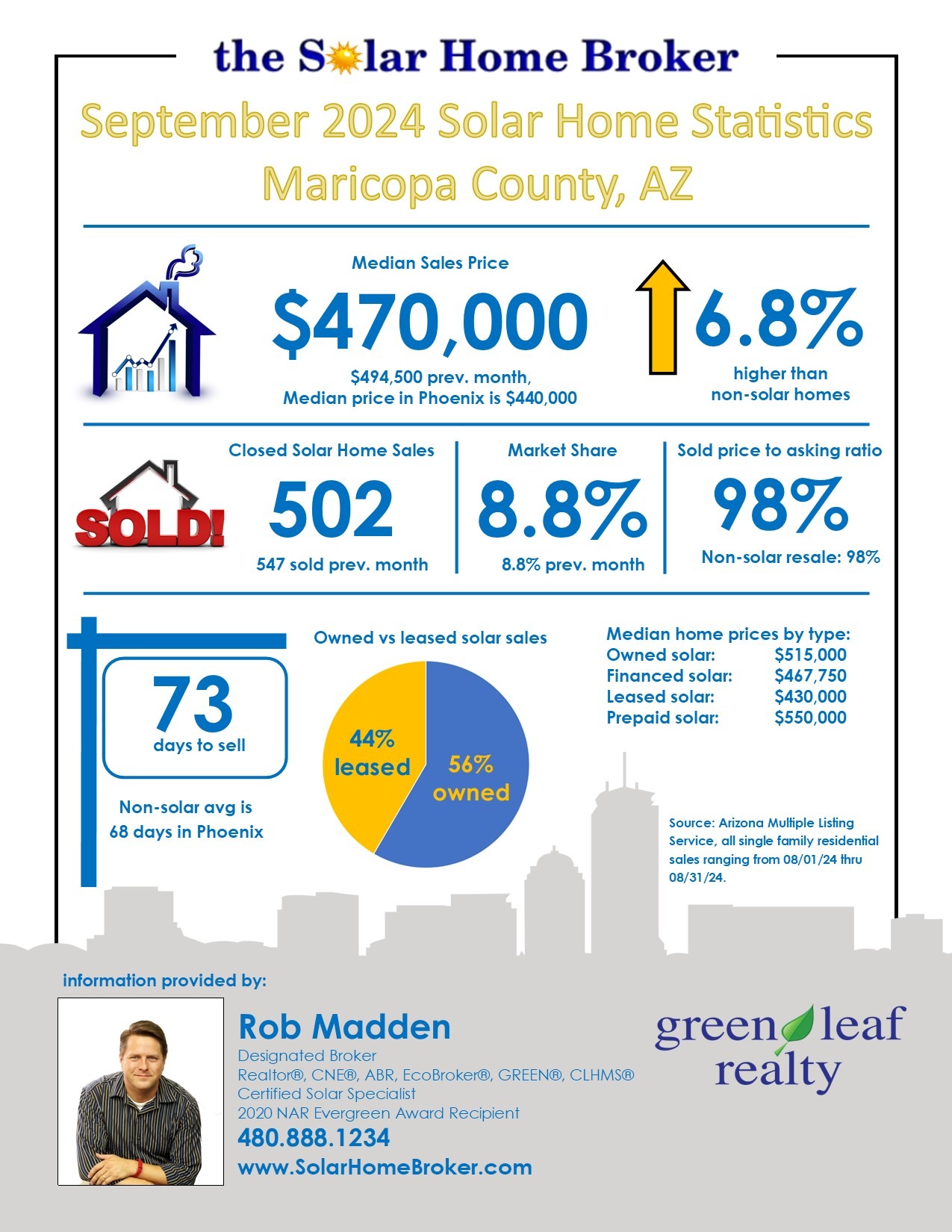
In August 2024, the median sales price for solar-equipped homes in Maricopa County saw a slight dip, reaching $470,000 from $494,500 in July. While this represents a modest decline, solar-powered homes remain a dynamic and valuable segment of the market, particularly due to the varying types of solar system arrangements:

  • Owned Solar Systems: Homes with fully owned solar systems commanded a premium, with a median sales price of $515,000. This trend reflects a strong buyer preference for ownership, as it eliminates ongoing payments and offers long-term financial benefits.
  • Financed Solar Systems: These homes saw a median price of $467,750, indicating continued demand among buyers willing to finance solar systems without the upfront cost of ownership.
  • Leased Solar Systems: Homes featuring leased solar systems fetched a median price of $430,000, reflecting a slight discount compared to owned systems due to the financial commitments tied to ongoing lease agreements.
  • Prepaid Leased Solar Systems: At the top end, homes with prepaid solar leases—eliminating future lease payments—saw a median price of $550,000, underscoring their appeal to buyers who want the benefits of solar without future financial obligations.

The market share for solar homes held steady at 8.8% in August, the same rate as in June and July, with 502 solar homes sold. This marks a decrease from the 547 solar home transactions recorded in July, pointing to some variability, possibly tied to broader economic conditions.

Pricing and Sales Performance

Solar homes in August 2024 sold for 98% of their listing price, a testament to their continued high demand and perceived value in the market. Non-solar homes also sold for 98% of their asking price, signaling that both segments are performing similarly in terms of negotiation and pricing. However, solar homes took slightly longer to sell, averaging 73 days on the market compared to 68 days for non-solar properties. This indicates that while buyers value the long-term benefits of solar, they may take more time to assess the higher price points and system complexities.

Market Preferences and Buyer Trends

The breakdown of solar home sales in August reveals distinct preferences among buyers:

  • Owned Solar Systems: Comprising 56% of the market, homes with owned solar systems continue to be the most sought after, appealing to buyers focused on long-term savings and property value enhancement.
  • Leased Solar Systems: Representing 44% of solar home sales, leased systems remain a significant portion of the market, appealing to buyers who prioritize immediate energy savings without the initial capital outlay.

Comparative Market Analysis

The broader Phoenix real estate market in August 2024 remained stable but dynamic, offering insight into the overall trends affecting both solar and non-solar home transactions:

  • Total Home Sales: The market recorded 5,724 home sales.
  • Median Sales Price: The general median sales price stayed steady at $440,000.
  • Average Sales Price: The average sales price edged upward to $638,304 from $602,490 in July, reflecting minor fluctuations in pricing across the market.
  • New Listings and Inventory: There were 8,801 new listings in August, contributing to a total inventory of 18,368 active listings, signaling a balanced supply in the market.
  • Absorption Rate: The absorption rate rose slightly to 3.21 months from 2.82 months, in line with typical seasonal adjustments during the summer months.
  • Cash Purchases: Cash transactions made up 21.5% of total sales, with a median price of $440,000, highlighting strong competition among cash buyers.

Conclusion

Despite a slight slowdown in the summer months, the market for solar-equipped homes in Phoenix remains robust and resilient. August 2024 data highlights the ongoing value that buyers place on sustainability and energy efficiency, which continue to drive interest in solar properties. As solar technology becomes more mainstream and accessible, its market appeal is expected to grow, positioning solar homes as a key player in Phoenix’s real estate landscape.

For real estate professionals and homebuyers alike, staying informed about these trends is essential. Understanding the financial and environmental advantages of solar energy can provide a competitive edge in the market, ensuring buyers and sellers are well-positioned to capitalize on the evolving demand for energy-efficient homes.

You can download a PDF version of the Maricopa County Solar Statistics by clicking: https://www.solarhomebroker.com/wp-content/uploads/2024/09/Maricopa-Solar-Stats-Sep-2024.pdf
Solar Homes Continue to Outpace Phoenix Real Estate Market – May 2024

Phoenix solar home sales statistics for May 2024

Phoenix’s Solar Home Market in May 2024: A Detailed Analysis of Trends and Economic Impact

As the Phoenix housing market moves from spring into summer, the solar home sector continues to showcase distinctive trends that differentiate it from the broader market. This past April, we’ve observed nuanced changes in pricing, sales volume, and market dynamics that provide deeper insight into the state of solar home sales. With environmental consciousness on the rise and economic factors at play, solar homes in Phoenix are not just a niche market but a significant part of the housing landscape.

Current Trends in Solar Home Pricing and Sales

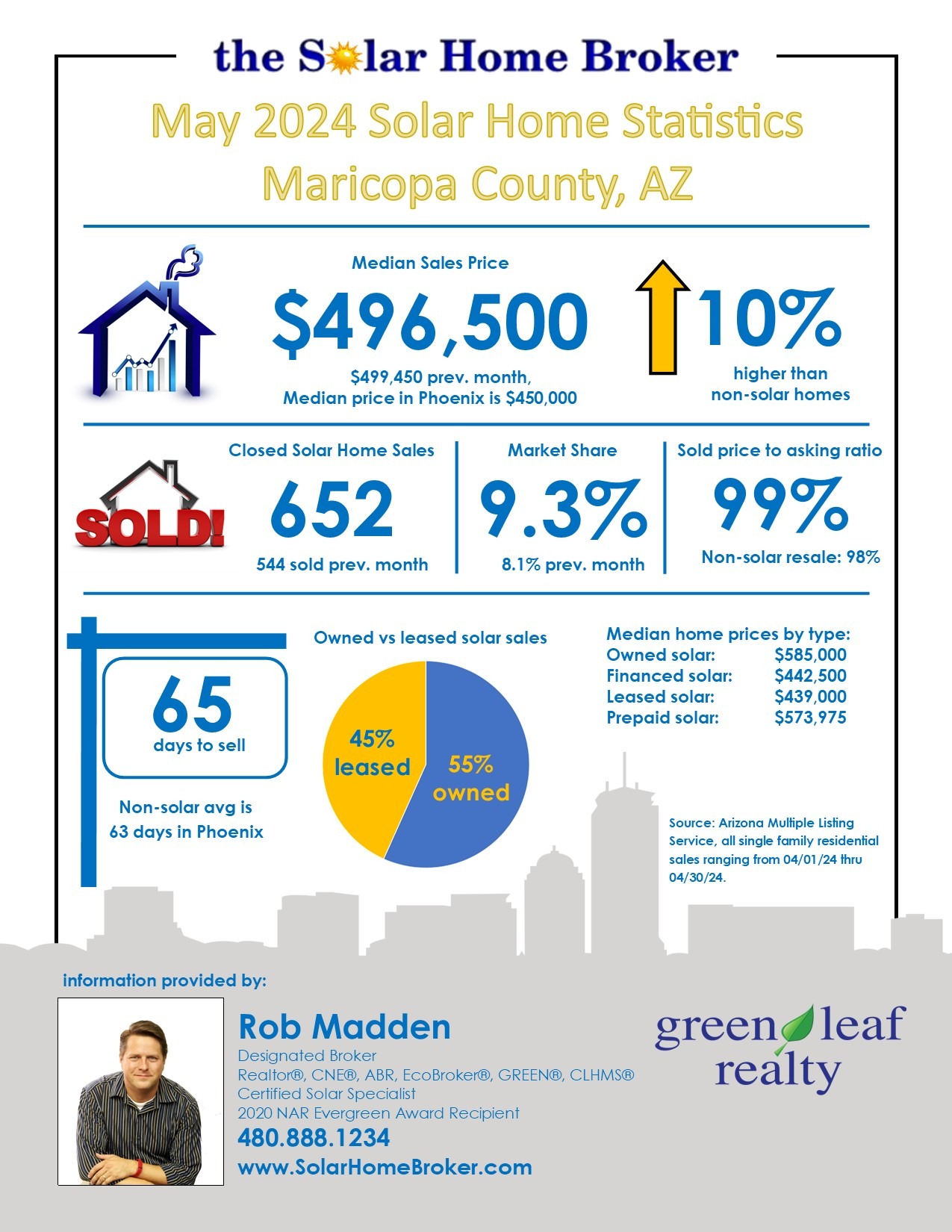
In April 2024, the median price for all solar homes in Phoenix rose to $496,500, marking a decrease from $499,450 in March. The specifics of the market, however, reveal more detailed shifts:

  • Owned Solar Systems: Homes with owned solar systems saw an increase in median price to $585,000 from March’s $562,500. These homes remain highly valued, suggesting that homeownership combined with solar capabilities is highly sought after due to the long-term savings and independence from utility companies.
  • Financed Solar Systems: The median price for homes with financed solar systems decreased to $442,500 from $452,000. This decline may reflect changing credit conditions or buyer caution in a fluctuating economic environment.
  • Leased Solar Systems: Homes with leased solar systems experienced a slight decrease to $439,000 from $449,500, indicating a steady interest in more affordable solar home options.
  • Prepaid Solar Lease Systems: The median price for homes with prepaid solar leases saw a significant adjustment to $573,975 from $608,675, possibly due to their perceived long-term value and the elimination of ongoing lease payments.

Comparison with the Broader Market

The median price for all resale homes in Phoenix was $450,000, which is slightly less than the median price for solar homes, reinforcing the premium that buyers are willing to pay for solar features. The broader market saw a mild increase from $444,945 in March, indicating steady growth across the board.

In terms of sales volume, 652 solar homes were sold in April, accounting for 9.3% of the total resale volume. This represents a significant segment of the market dedicated to environmentally friendly living solutions.

Historical Context and Year-over-Year Changes

Comparing year-over-year data, the median price of solar homes has increased by an impressive margin from April 2023, significantly outpacing the general market’s growth. This robust appreciation reflects the increasing valuation of solar technology in residential properties. However, the volume of solar homes sold has experienced fluctuations, suggesting market dynamics influenced by various factors such as economic conditions and buyer preferences.

Market Health and Economic Indicators

Phoenix’s housing market remains tight with just above 17,000 units available, up 39% from last year, yet still limited in the context of growing demand. With a supply of just 2.4 months, the market conditions favor sellers, keeping competition high among buyers. Foreclosure rates remain low, indicating a healthy market overall.

Mortgage rates have stabilized around 7%, still higher than the preferred 5% or lower, which continues to impact buyer affordability and seller willingness to list properties. The economic outlook is cautiously optimistic, buoyed by controlled inflation and the potential for interest rate reductions by the Federal Reserve, which could invigorate the market further.

Conclusion

As we analyze the solar home market in Phoenix in April 2024, it’s clear that these homes are more than just an eco-friendly option; they are a significant and growing component of the housing market landscape. With their ability to attract higher offers and close at rates above non-solar homes, solar properties offer compelling value, both in terms of real estate investment and environmental impact. Looking ahead, the solar home market in Phoenix is poised for continued growth and evolution, shaped by technological advancements, economic factors, and increasing consumer demand for sustainable living options.

You can download a PDF version of this report by clicking: https://www.solarhomebroker.com/wp-content/uploads/2024/05/Maricopa-Solar-Stats-May-2024.pdf

A version of this article can be found at: https://www.phoenixhomebuying.com/maricopa-county-solar-home-sales-may-2024/

Phoenix Solar Home Sales Feb 2024: Rising Demand & Market Trends

Phoenix February solar home sales statistics

Phoenix Solar Home Sales in February 2024: A Beacon of Stability in a Shifting Market

As we stepped into January 2024, the Phoenix real estate market continued to exhibit signs of stability and growth, particularly within the solar home segment. This period offered a clear view into how sustainable living practices are becoming increasingly integrated into the mainstream housing market, reflecting broader economic trends and consumer preferences.

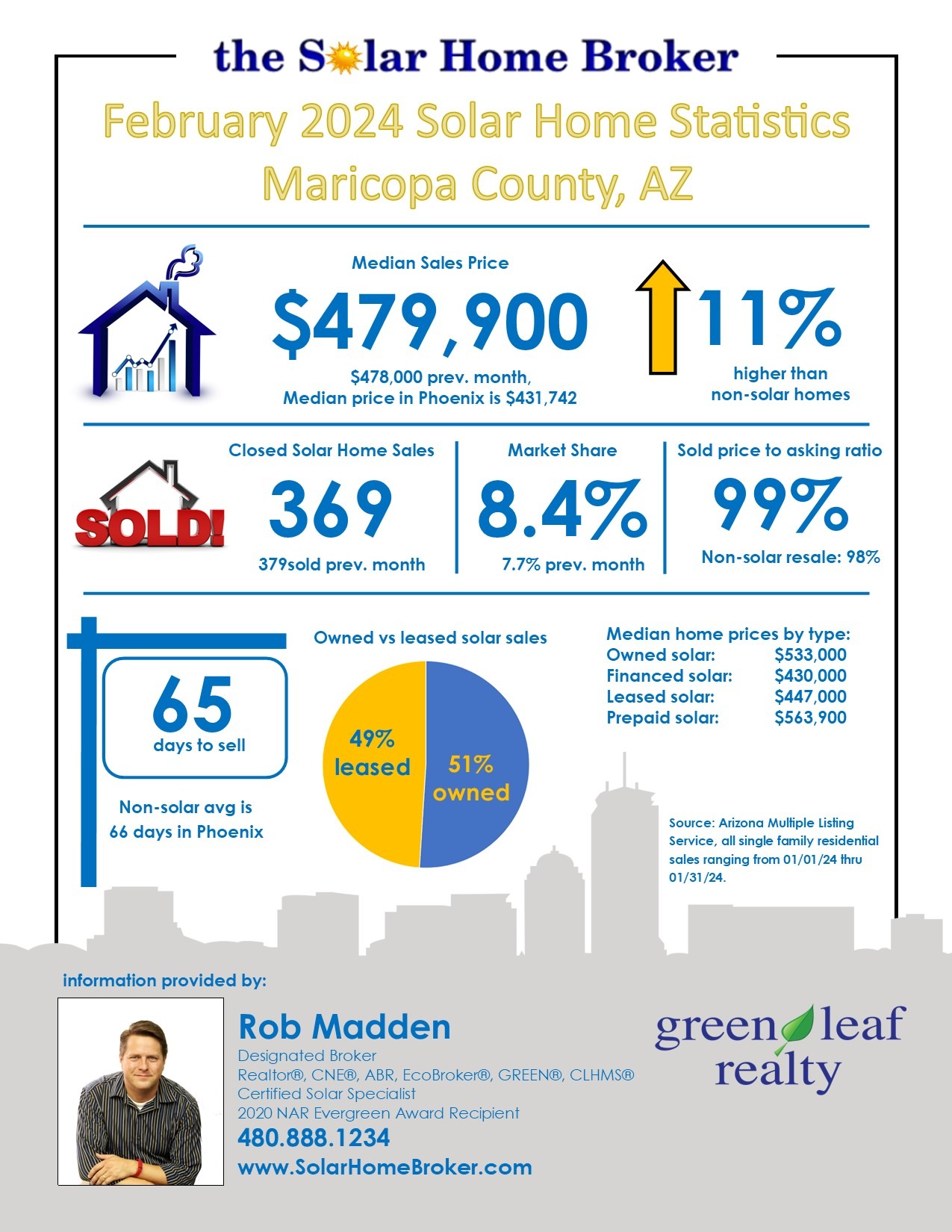
In January, the median price for solar homes in Phoenix was slightly adjusted to $479,000, a minor dip from December 2023’s $478,000. This subtle change belies the significant shifts occurring within various categories of solar homes. Owned solar systems, for instance, saw their median price increase to $533,000 from December’s $515,000, indicating a robust demand for solar homes that buyers fully own. Conversely, homes with financed solar systems experienced a decrease to $430,000, suggesting possible adjustments in financing conditions or buyer priorities. Homes with leased solar systems saw an uptick to $447,000, while those with prepaid solar lease systems adjusted downwards to $563,900, revealing nuanced buyer sentiment towards different solar arrangements.

The overall Phoenix resale market also experienced a slight increase in median prices, reaching $431,742, up from $429,900 in December 2023. This incremental rise reflects a broader market stability amidst fluctuating economic indicators.

January’s sales volume of solar homes stood at 369, representing 8.4% of the total resale volume, a slight increase from December’s figures. This continued interest in solar homes underscores a sustained market appeal, with sellers receiving 99% of their asking price, a figure that surpasses the average for non-solar homes in Phoenix, which stood at 98%.

The composition of solar home sales, with a 51% to 49% split between owned and leased systems, highlights the diverse appeal of solar energy solutions in the residential sector. Interestingly, solar homes took an average of 65 days to sell, comparable to the 66-day average for all resale homes in Phoenix, indicating a balanced market demand for solar-equipped properties.

Year-over-year analysis reveals a 6.88% increase in the median price of solar homes, compared to January 2023, underscoring the growing value proposition of solar investment in residential real estate. The volume of solar home sales also saw a 6.3% increase from the previous year, further evidence of the sector’s resilience and appeal.

The general health of the Phoenix housing market remains robust, with inventory levels maintaining a steady state below the 16,000-home mark, a significant increase from five months prior. This equates to a 3.5-month supply of homes, maintaining a competitive market without tipping into oversupply. Foreclosure rates at 0.7% remain minimal, indicating healthy financial conditions among homeowners.

Mortgage rates, slowly easing from previous highs, have begun to offer some relief, though the market still feels the pinch of rates significantly above the desired 5% threshold. This environment has led to a cautious stance from both buyers and sellers, with the latter particularly hesitant to enter the market under less favorable financial terms.

Looking forward, there is a palpable sense of optimism as the new year begins, buoyed by controlled inflation and the potential for federal interest rate decreases. This optimistic outlook could stimulate further activity in the housing market, particularly for solar homes, as they represent not only a sustainable choice but also an increasingly savvy investment in Phoenix’s competitive real estate landscape.

In conclusion, the solar home market in Phoenix as of January 2024 stands as a testament to the growing integration of sustainability within the broader real estate market. The slight fluctuations in pricing and sales volume reflect a market in flux but also indicate a resilient interest in solar homes. As the year progresses, it will be interesting to observe how broader economic indicators and specific market dynamics continue to shape the solar home landscape in Phoenix, potentially setting the stage for further growth and innovation in sustainable living solutions.

You can download the updated Phoenix solar home statistics in PDF format here: https://www.solarhomebroker.com/wp-content/uploads/2024/02/Maricopa-Solar-Stats-Feb-2024.pdf

Solar Homes in Phoenix: A Steady Beacon in a Tumultuous Market November 2023

November 2023 Phoenix solar home sales statistics

As the year 2023 wanes, the Phoenix housing market continues to display its unique dynamics, particularly within the solar home segment. October’s data paints a picture of resilience and nuanced shifts, especially when contrasted with the broader market.

The median price for solar homes in Phoenix for October stood at $474,900, a slight uptick from September’s $469,500. This increase, subtle yet indicative, reveals more when dissected. Homes with owned solar systems, which traditionally lead the market in terms of value, saw a decrease to $550,000 from September’s $565,000. However, homes with financed solar systems experienced a climb to $474,000, a notable jump from the previous month’s $449,950. Likewise, leased solar system homes edged up to $425,000, and those with prepaid solar lease systems markedly increased to $618,850. These figures suggest a diversifying market where different types of solar systems cater to varied buyer preferences and economic capacities.

The median price for all resale homes in Phoenix was $435,000, marginally up from September’s $432,190, demonstrating a broader market resilience. The solar home sector, however, continues to outperform the general market in certain aspects. A total of 415 solar homes were sold, representing 8.0% of October’s total resale volume. This sales figure, while slightly lower than September’s, remains significant and underlines the steady demand for solar-equipped properties.

Notably, sellers of solar homes received 100% of their asking price, outshining the 98% received by sellers of non-solar homes. The close balance between owned (50.3%) and leased (49.7%) solar systems in sales underscores a market that appreciates both the long-term investment of ownership and the flexibility of leasing.

Historically, the median price of solar homes has risen by 3.24% from October 2022, showcasing a year-over-year growth that contrasts with the broader resale market’s stagnation. Additionally, the volume of solar homes sold has increased by 13.7% year over year, a testament to the growing appeal of eco-friendly living in the face of climate challenges.

The general market health in Phoenix, however, reflects the complexities of the current economic environment. Inventory levels remain tight, with just below 16,000 homes available, a 37% increase from three months ago. This inventory translates to a three-month supply, indicating a market that is neither overflowing nor excessively strained. Foreclosure rates, at a minimal 0.5%, reinforce this view of a market not plagued by distress sales.

Mortgage rates, having recently retreated from the 8% high, continue to exert pressure on the market. The higher rates are deterring some potential buyers, especially those reminiscing about the sub-5% era. Sellers, too, are reluctant to exchange their low-interest rate mortgages for the uncertainty of current rates. This hesitancy on both ends keeps the inventory levels from ballooning, maintaining a balance in the market.

In conclusion, as we navigate through October 2023, Phoenix’s solar home market emerges as a segment marked by resilience and adaptability. The fluctuating prices across different solar home categories reflect a market that is responding to diverse buyer needs and economic realities. With mortgage rates being a key influencer, the future trajectory of this market will likely hinge on broader economic trends. However, the sustained interest in solar homes highlights a deeper, more enduring shift towards sustainability – a trend that may well define the future of residential real estate in Phoenix.

You can download a PDF version of the monthly solar sales statistics here: https://www.solarhomebroker.com/wp-content/uploads/2023/11/Maricopa-Solar-Stats-Nov-2023.pdf

Phoenix Solar Homes: Seamless Sunrun Transfer Guide

Sunrun solar transfer in Phoenix AZ

Simplifying the Transfer of Sunrun Solar Service for Home Sellers in Phoenix, AZ

When it comes to selling solar homes in Phoenix, AZ, one of the critical aspects that both home sellers and buyers need to navigate is the transfer of solar service agreements. Specifically, for homes equipped with Sunrun Solar Services, understanding and executing this process is crucial. In this article, we delve into the necessary steps and provide insights on making this transition as seamless as possible.

Sunrun Solar Transfers

The Sunrun Solar Service Transfer process is straightforward and demands attention to detail from both the home seller and buyer. As soon as a seller receives an offer on their solar home, they should promptly contact Sunrun by emailing servicetransfers@sunrun.com, providing essential contact information for both parties involved. It’s crucial for the seller to also authorize their listing agent to act on their behalf throughout the transfer process, ensuring all aspects of ownership and responsibility are adequately addressed.

Both the seller and buyer are required to sign the “Transfer of Sunrun Solar Service Agreement,” a document that is sent electronically for convenience. This stage also involves the buyer completing a soft credit application, ensuring that they meet the necessary financial criteria without affecting their credit score or home loan prospects.

To finalize the transfer, proof of title transfer must be submitted after closing, and this can include a variety of legal documents such as a final settlement statement or a recorded grant deed. It is recommended that the solar agreement and its transfer are disclosed early in the home selling process and made a contingency of the sale. This proactive approach ensures that all parties are aware of the commitments and processes involved, minimizing potential issues and misunderstandings.

When selling a solar home in Phoenix, AZ, choosing professionals familiar with rooftop solar, such as agents, lenders, and title companies, is vital. Rob Madden with Green Leaf Realty, a Realtor specializing in solar homes, brings expertise and understanding to the table, ensuring that the transfer process is handled efficiently.

Communicating Sunrun Solar Benefits

Additionally, it’s beneficial to communicate the advantages of Sunrun Solar Services to potential buyers. Highlighting that the home provides less expensive power at a fixed rate, and emphasizing the fast-selling nature of solar homes, can attract buyers and facilitate a quicker sale. Also, positioning the home as a hybrid solution, receiving electricity from both Sunrun and the local utility company, appeals to environmentally conscious buyers.

Sunrun’s popularity among homeowners is evident, with 75% of homeowners choosing third-party solar services over outright ownership. By choosing a Realtor specializing in solar homes, such as Rob Madden with Green Leaf Realty, sellers can navigate the transfer of Sunrun Solar Service smoothly, ensuring a positive experience for all parties involved and maximizing the appeal of their solar home in the competitive Phoenix real estate market.

In conclusion, selling a solar home in Phoenix, AZ, requires a comprehensive understanding of the Sunrun Solar Service transfer process. By following the outlined steps, choosing experienced professionals, and effectively communicating the benefits of Sunrun services, sellers can ensure a seamless transition and attract eco-conscious buyers, ultimately contributing to a successful and efficient sale.

A version of this article can be found at: https://www.phoenixhomebuying.com/guide-to-transferring-sunrun-solar-services-for-phoenix-home-sellers/

Phoenix Solar Calculator: The Power of the Kilowatt Hour

solar calculator

Solar Calculator – Watt’s your kilowatt number?

Phoenix basks in the glory of sunshine, and it’s not just about golden sunsets and tan lines; it’s about turning that abundant sunlight into power and potential property value. For home sellers with solar rooftops, understanding the significance of the cost per kilowatt hour (kWh) isn’t merely technical jargon—it’s a potent tool to determine whether your property will shine in the market or cast a shadow over potential sales.

Why the Kilowatt Hour Matters

In the grand mosaic of solar power dynamics, the kWh is the linchpin. It’s the unit measuring how much electricity your solar system produces and, crucially, how much it could save or cost a potential buyer. With the APS (Arizona Public Service) time-of-use rate plan, the kWh isn’t just a fixed value; it ebbs and flows based on the time of day and year.

Your Solar Advantage: Breaking Down the Numbers

For homes tapping into Phoenix’s sunlight when compared to APS’ 4pm to 7pm time of use plan:

  • 63% of energy is generated during off-peak hours
  • 14% during super off-peak hours in winter
  • 23% during on-peak hours

Given the varied rates APS offers, this energy generation can translate into tangible savings or costs. For instance, during summer months, the cost difference between on-peak ($0.2978 per kWh) and off-peak ($0.10789 per kWh) is significant. Similarly, the winter months offer the advantage of a super off-peak rate at just $0.03166 per kWh.

How Does Your Solar System Stack Up?

A solar calculator tailored to these local parameters can be transformative. As a seller, inputting your home details and solar specifications will offer insights into:

  • Potential savings for the buyer
  • How your solar setup compares to market expectations
  • Whether your solar system adds value or poses a challenge to your sale

The Buyback Potential: An Added Edge

Here’s a bonus: homes that produce excess energy can benefit from APS’s buyback rates, which range from $0.08465 to $0.129 per kWh. A solar calculator will gauge your potential earnings from this buyback, emphasizing another layer of value to potential buyers.

A Powerful Selling Tool

In a market brimming with competition, knowledge is power. Understanding the kWh cost your solar system offers equips you with the data to showcase your home’s long-term financial and sustainable advantages. It’s not just about having solar panels; it’s about demonstrating their tangible benefits.

For potential buyers, the cost savings and sustainable living prospects can be compelling. By presenting them with clear, data-backed insights, you’re not merely selling a home; you’re selling a vision of eco-friendly, economically savvy living.

To Solar or Not to Solar?

In Phoenix, where the sun generously bestows its energy, a solar rooftop can either be a coveted asset or a debated liability. By leveraging a solar calculator, home sellers can decipher where they stand. The cost per kWh your system generates will either bolster your sale, positioning your property as a cutting-edge, eco-conscious haven, or pinpoint areas for improvement before listing.

Ensuring your home’s solar system is an asset rather than an Achilles’ heel is essential. Dive deep into the kWh dynamics, harness the power of a solar calculator, and illuminate the true value of your Phoenix home.

To find out your cost per kilowatt hour, input your information below:

[solar_calculator]

Using Your Cost per Kilowatt Hour

Using your number above, is it costing you more or saving you more:

  • during ON PEAK hours (from 4pm to 7pm)?
  • during OFF PEAK hours (7pm to 4pm)?
  • during SUPER OFF PEAK hours (10am to 3pm during winter months) kick in?
  • if you have to sell excess electricity back to APS?

Remember, even if you are receiving a check back from APS each month as a credit on your bill, what is the cost of it? If it costs you, for example, $0.15 to generate a kilowatt hour of electricity that you end up sending back to APS because you didn’t use it, what is your buyback rate? $0.08465 per kilowatt hour? That is a net loss of $0.065 for every kilowatt hour you send them. That doesn’t make a lot of sense.

On the other hand, if you own your system free and clear, none of this matters because the savings are there each month.

If you have questions on whether or not your solar will affect the sale of your home, give me a call at 480-888-1234 and let’s discuss it.

How A Mortgage Affects the Sale of a Solar Home in Phoenix

mortgages and solar home sales

How a mortgage affects the sale of a home in Phoenix.

Owning a home adorned with shiny solar panels in sunny Phoenix is an exciting prospect. But, hey, we get it! The financial side, especially understanding mortgages and loans, can be a bit tricky. Let’s explore, in straightforward terms, how different loan options work for purchasing a solar home in the Phoenix area.

Conventional Loans: Your Everyday Mortgage

These are your standard loans, often used by many. They’re guided by rules set by Fannie Mae or Freddie Mac, which are entities that buy and package mortgages. Fun fact: You can snag a conventional loan by putting down as little as 3% and choose between a 15 or 30-year payoff plan.  Additionally, solar lease payments are not added to your qualifying ratios (though a solar loan payment would be added unfortunately).

When it comes to homes with solar panels, there’s a special form (the “Residential and Green Energy Efficient Addendum”) that appraisers use if the solar system is owned and not leased. A tiny hiccup to keep in mind: if you purchased solar panels under the PACE program (specific to California), Fannie Mae won’t back the loan. But since we’re in Arizona, no worries there!

FHA Loans: Friendly and Adaptable

FHA loans are known for being user-friendly with flexible rules. The Federal Housing Administration (FHA), a part of the U.S. Department of Housing and Urban Development (HUD), ensures these loans. They’re renowned for their lower down payments and more lenient guidelines.

When solar comes into play, FHA has cool specifics. They allow mortgage amounts to go beyond 20% of the max allowable FHA home loan if that excess is used to install a solar system. Plus, with an FHA Energy Efficient Mortgage (EEM), you can finance up to $10,000 for energy improvements (like solar panels) with as little as 3.5% down.

Another neat offer from FHA is the Title I loan, providing funds for energy improvements even if you’ve not much equity in your home. Although rarely used for initial home purchases, it can be a boon for existing homeowners in Phoenix wishing to shift to solar without leasing.

VA Loans: A Salute to Service

Here’s a shoutout to our military veterans! VA loans are tailor-made for you, requiring no money down and are, in general, a fantastic deal.

When we bring solar into the picture, VA has specific guidelines, notably in VA Pamphlet 26-7, regarding how solar systems are valued and qualified. Similar to other loan types, if the solar system is a permanent part of the home and not leased or financed, it adds value.

VA also has an energy-efficient mortgage, but it’s worth noting that it’s not commonly offered by most lenders in Phoenix.

In a Sunbeam: The Link of Loans and Solar

Regardless of the loan type, Phoenix has proved to be a sun-drenched paradise for solar homes. However, diving into the financial aspect, particularly loans, requires a little light to be shed on the intricate details.

Through the lens of conventional, FHA, and VA loans, potential solar homeowners can navigate the sea of financial jargon and lay the foundation for their luminous abode in the vibrant heart of Arizona.

The takeaway? While each loan type has its unique shades, the underlining fact remains that turning your home into a beacon of sustainability with solar is certainly plausible. And with the right financial route, you can bask in the glow of both the sun and smart, future-proof investment in a solar home in Phoenix.

Selling Your Solar Home in Arizona

Turn solar into sold

Shining a Light on the Myths About Solar Homes

You’ve heard it often – real estate agents whispering that solar panels make selling a home in Arizona trickier and slower. But hold on a minute, is there any truth to that? Well, not really! It turns out, many of these agents might not fully understand how to showcase the fabulous pluses of a solar home to possible buyers. So, why are some Phoenix solar home owners choosing these agents, who see their energy-saving solar setup more like a hurdle than a selling point?

Tackling the Why and How of Solar Benefits

Here’s the scoop – the agents might not know how to talk about solar homes in a way that gets people excited. Maybe they don’t quite get how solar technology works or perhaps they don’t realize all the cool perks you’ve gotten from your solar system since you installed it.

Experience Talks: Shaping a Pro-Solar Selling Strategy

In the 30+ years of working in real estate, with a good 12 years zeroing in on selling solar homes in the Phoenix area, there’s been a lot of learning and understanding about how to do it right! After seeing what works (and what doesn’t!), I have crafted a 7-Step plan to make sure your solar home gets the top-notch value it truly deserves.

Stepping Up the Solar Game: Empowering Buyers and Agents

With a specialty in solar and knowing all the ins and outs of energy efficiency, it’s clear that many buyers are being led by agents who might not be able to tell them about the awesome benefits and advantages of going solar. This 7-Step plan swoops in to fix that, educating both the buyer and the real estate agent and showing how your solar setup will save them bucks on their electric bills each month.

Picking the Right Guide: Don’t Settle for Less!

Want to know the secret sauce to selling your solar home in Arizona? Get the right solar real estate agent on your team BEFORE you put your home on the market! Even though loads of people manage to pass the real estate exam in Phoenix, not all of them know the special details of selling a solar home. Don’t let your home be a practice round for an agent who’s still figuring things out!

Avoiding Pitfalls: Navigate the Sale with Confidence

Choosing an agent without experience in solar homes could mean stumbling into unnecessary mistakes and waits while they try to learn on the job. Your home, and indeed your wallet, deserve better than being a learning experience for someone else!

Championing Solar Sales with Certified Expertise

As a certified EcoBroker and GREEN Realtor, plus being certified in energy auditing from the Building Performance Institute (BPI), there’s a lot of know-how in selling homes that have all sorts of solar setups, whether leased or owned. And the goal is to use all that expertise to help you!

Let’s Illuminate Your Path to a Successful Sale Together!

Ready to talk about how to get your solar home sold in a way that truly values its worth? Dial 480-888-1234, and let’s chat about putting your solar home in the spotlight, ensuring it attracts buyers who will appreciate its true value!

Tesla / SolarCity Solar Lease Transfers for Phoenix Solar Homes

Tesla / SolarCity lease transfer in Phoenix

Harnessing the Sun, Powering the Sale: Your Comprehensive Guide to Transferring a Tesla / SolarCity Solar Lease in Phoenix

Phoenix, AZ, radiates not just with its vibrant desert landscape but also as a hub where homes are empowered by the brilliance of the sun, thanks to solar systems like those provided by Tesla / SolarCity. As a Phoenix homeowner, if you’re considering selling your abode and it’s powered by Tesla / SolarCity’s solar products, you may wonder how to smoothly transfer your solar lease to the new owners. Ensuring a seamless transfer will not only uphold your obligations as a seller but also showcase your transparency and responsibility.

Understanding Tesla / SolarCity’s Solar Lease

Tesla / SolarCity’s solar lease, particularly popular in sunny locales like Phoenix, is an arrangement where you, the homeowner, lease the solar system from Tesla / SolarCity, reaping the benefits of the generated energy while paying a fixed monthly fee. When you decide to sell your home, it’s crucial to navigate the lease transfer process adeptly to ensure a smooth transition for both you and the buyer. Below is your straightforward guide to illuminate every step of this journey.

Part 1: Initiating the Transfer Process

It’s pivotal to kickstart the transfer process as soon as you enter a contract with a buyer (if not before but an experienced solar Realtor will have already advised that). As the system owner, you hold the key to initiate the contract reassignment process. Let’s distill the primary steps:

  • Sign in to Your Tesla / SolarCity Account: Navigate to the energy product you are transferring.
  • Transfer System Ownership: Within the ‘Transferring Your System’ section, select ‘Transfer system ownership,’ entering crucial details like the transfer type, status, assuming party, and escrow details.
  • Comprehensive Communication: Engage openly with the buyer to ensure they comprehend their new obligations under the solar agreement and to answer any questions they might have. Most likely you should have had the buyer sign a solar lease/loan addendum as part of the purchase contract that will contractually obligate them to this process.

Part 2: Ensuring Legal and Financial Compliance

The ownership transfer isn’t merely a physical handover; it involves due diligence in handling the financial and legal aspects:

  • Addressing the UCC-1 Financing Statement: Though not a lien, a UCC-1 financing statement indicates Tesla / SolarCity’s ownership of the solar system. For financing purposes, this may need to be temporarily released or subordinated, necessitating a $150 document processing fee paid by the seller.
  • Handle Final Invoicing: You’ll receive a final invoice within two billing cycles post-Close of Escrow on the home, covering energy produced (for PPAs) or monthly lease payments through Close of Escrow.

Part 3: Navigating Diverse Contract Types

Tesla / SolarCity offers various financing options, and each carries a unique protocol during home sales:

  • Cash Purchases: Directly contact Tesla / SolarCity’s Customer Support team.
  • Third-Party Loans (e.g., Mosaic, Sunlight): Engage with your loan provider to transfer the contract, contacting Tesla / SolarCity post-home sale.
  • Tesla / SolarCity Loans: Connect with the Tesla / SolarCity Finance team at 844-837-5285, selecting option 2.

Part 4: Bridging to the New Homeowner

Post-transaction, the responsibility to inform Tesla / SolarCity about the closure falls upon you, ensuring all systems update to reflect the new owner under the solar agreement. The new owner simply continues where you left off—no restarting of terms, ensuring a seamless transition and consistent solar service.

Part 5: Available Assistance

Tesla / SolarCity’s specialized Property & Title team, laden with real estate expertise, stands ready to assist both sellers and buyers. Once they receive authorization from the initial contract holder, they can share detailed solar agreement information and address queries, ensuring every party is well-informed.

Contacting Property & Title

  • Online Requests: www.tesla.com/realestate
  • Phone Number: 1 (877) 650-7652

A Spotlight on Responsibility

By ensuring a thorough and transparent transfer process, you not only uphold your obligations but also shine a light on responsibility, fostering a trusting relationship with the buyer and ensuring the continued utilization of sustainable solar energy in Phoenix homes.

Commonly Asked Questions:

What can I do with my Tesla / SolarCity solar system agreement if I’m selling my house in Phoenix?

You’ve got a couple of options:

If Tesla / SolarCity owns the system, you can usually transfer your agreement to the person buying your home. They’ll continue where you left off. If you want to check other choices, look at your contract on your Tesla account.

If you own the system, no need to transfer the contract if you bought your panels with cash or used another financier. The warranties stay with the system. Once you sell, tell the Property & Title team at Tesla / SolarCity, so they can update your account.

How do I move the Tesla / SolarCity solar agreement to the new homeowner in Phoenix?

Here’s a simple path if Tesla / SolarCity owns the system:

  • Tell Tesla / SolarCity early: Let the Property & Title team know as soon as you decide to sell.
  • Be clear with buyers: Make sure anyone looking to buy knows about the solar system and its agreement.
  • Inform Tesla / SolarCity about the buyer: Once you have a buyer, make sure they chat with the Property & Title team too.
  • Easy paperwork: Tesla / SolarCity will give you an online form to sign. It’s easy and digital!
  • Make it official: After the home sale is done, Tesla / SolarCity will put the new owner’s name on the account.

If you own the system, no need for paperwork. Just share the new deed with the Property & Title team, and they’ll update the account.

Can my renter in Phoenix take over the solar contract with Tesla / SolarCity?

You can let anyone, like your renter, have access to the account, but the homeowner’s name must stay on the contract. But be careful, because your renter will see personal info like billing details. It might be better to keep the bill in your name and have your renter pay you back.

Does the buyer need to qualify to take over the solar agreement in Phoenix?

If Tesla / SolarCity doesn’t own the system or it’s been fully prepaid, no worries about qualifying. If there’s a monthly payment to Tesla / SolarCity, the buyer can qualify by:

  1. Meeting Tesla / SolarCity’s credit standards.
  2. Buying the home with cash.
  3. If those two don’t work, they can pay a $250 credit fee.

Anything I should think about with the Tesla / SolarCity solar system before accepting an offer on my Phoenix home?

  • If Tesla / SolarCity owns it, make sure potential buyers and your real estate agent know about the solar agreement. You might want to make the transfer of the solar agreement a condition of the sale. Also, think about the buyer’s financier and if they’re okay with a home that has a solar agreement.
  • If you own the system, simply let the Property & Title team at Tesla / SolarCity know and provide the new deed when your home is sold.

Can my Tesla / SolarCity panels’ value be part of my Phoenix home’s price?

If you own the solar system, yes, it can be part of the home’s appraised value. If you don’t own it, it usually isn’t included in the property’s value.

Final Thoughts

As you journey from the contemplation of selling your home to handing the keys to the new owner, knowing that you have responsibly transferred your Tesla / SolarCity solar lease not only amplifies your credibility but also perpetuates a chain of sustainability in the heart of Phoenix. May every sunrise in your new abode bring you as much energy and brightness as your previous Tesla / SolarCity-powered home!

Renting Out Your Phoenix Solar Home? Solar Leases or Owned

Risks and rewards to renting out a solar home in Phoenix

Renting Out Your Solar Home in Phoenix?

There may come a time in your life when you decide that it is time to move from your solar powered home but you may not want to sell it.  Having a renter in your home to pay down your mortgage, care for the property, and allow for more property appreciation may be an option to consider if you need to move and you can financially do it.  However if you have solar power on the home, there are several questions you and your property manager (if you hire one) need to work out before renting out the home.

The discussion of leasing your solar powered home falls into two categories (much like solar home sales do) – 1) homes with solar that is owned and 2) homes with a solar lease.

Owned Solar on the Home

When you are leasing out a home with solar as a fixture, i.e. you own the system outright, questions of liability, maintenance, and cost stand out in the forefront.

In terms of liability, is there any additional liability that you, the landlord, assume because of the solar system?  Are you guaranteeing performance of the solar system through your advertising by showcasing the cost savings of electricity?  What happens if the solar system does not perform as you had described to the tenant?  If the system fails, are you responsible for the higher utility bills until the system is fixed?  Who is responsible for fixing the system?  If damages occur as a result of the system, do you have additional insurance and contract clauses in the lease agreement to protect you?  As the landlord, do you have additional insurance to cover the cost of replacement of the system if the house is damaged?

In terms of maintenance on a home that you plan on renting out with a solar system, who is responsible for maintaining the system? Is the tenant allowed to make alterations to the home that could affect the solar system?  Does the tenant have the obligation to maintain the vegetation to avoid excessive shading of the solar system?

In terms of cost, will you pass the full savings off of the tenants utility bill to the tenant or will you charge the tenant a surcharge for use of the solar system? I ask this question because over time, there will be maintenance and component costs that you will incur.  If, for example, the inverter fails and you must replace it, do you have a reserve fund established because of a solar surcharge you tacked onto the rent?  Will you use the solar as an incentive to distinguish yourself from your competition and not charge a solar surcharge?  Can you ask for more in rent instead?

Solar Leases and Rentals

For homes that have a solar lease, the previous three categories of liability, maintenance, and cost apply but because you do not own the system and it is leased by a third party that the tenant does not have a contractual obligation to, you need to address your obligations to the solar leasing company in your lease agreement to your tenant.

In most solar leases, there are provisions that address the limited liability obligations of the solar company but do those protections pass to your tenant as well–the lease is only between you and the solar company and the tenant is not a party to the solar lease.  Do you need additional insurance coverage to protect your tenant?  Does the solar leasing company need to be notified?  Are there any provisions in your solar lease that would void any of the liability protections if you did rent out the home?

In terms of maintenance, most solar leases have clauses that require the home owner to ensure that the panels are cleaned and free from shading.  Do you have clauses in your lease addressing your obligations for maintenance and panel cleaning?  What about access to the solar system on the home?  Do you have clauses that allow for the solar leasing company to gain access to the home to check the system if it is not operating properly and will you have to be there as well?

Most solar leases, unless it is a prepaid solar lease, have a monthly fee that the home owner must pay for the duration of the lease.  Are you or the tenant responsible for paying that fee?  If the tenant is responsible, do you have contingency plans and contract clauses that address non-payment of the solar lease?  If the tenant fails to pay the solar lease on time, will that affect your credit report?  Furthermore, some solar leasing companies require the home owner to have an internet connection so that they can monitor the energy production of the solar system.  Are you or the tenant responsible for maintain an internet connection for the solar system?

Conclusion

Overall solar can be a very attractive feature for a rental home in the Phoenix area.  It affords a tenant to be eco-conscious while saving on their utility bills.  The idea of being able to save hundreds a year off of their utility bill is as attractive to tenants as it is home owners.

Be careful before renting out your house though.  You have certain obligations, especially under a solar lease, that you must fulfill and the standard real estate lease agreement fails miserably to address anything about solar in the leases.  Read through your lease and talk with your leasing company.  Make sure that your lease addresses any potential liability or obligations that you must fulfill, whether you do it or your tenant does it.

Questions, please feel free to give Rob Madden, the Solar Home Broker, a call at 480-888-1234.